
Wood is making its come back in Japan!
Wood once played a central role in traditional Japanese architecture. However, with globalization, industrialization, and concerns about fire risks, its use gradually declined in favor of materials such as concrete. In this article, we will first explore why wood was — and once again is — a fundamental element of Japanese architecture, and then examine how contemporary Japanese architects are reintroducing it today.
Wood: An Abundant Resource Rooted in Tradition
Japan is covered by forests across 66% of its territory, primarily composed of cedar. Forestry has been practiced there for centuries.

Forest after Daisugi Cut
Credit : ArticleStunning Lifestyle
One remarkable technique is Daisugi, which involves carefully pruning cedar trees by hand every two years. Only the upper branches are preserved to allow new shoots to grow. This method avoids cutting the tree down entirely and ensures a sustainable supply of straight timber.
Video about Daisugi
Credit :Youtube /Destination Tips
During the Edo period (1600–1870), a long era of peace in the Japanese archipelago, the arts flourished. Architecture shifted toward leisure and commerce, and craftsmanship became increasingly refined.


Katsushika Hokusai, Kanagawa Wave 神奈川 Echigoya Mitsui Shop (from « Trente-six vues du Mont Fuji »), 1831
Credit : Japan Experience (japan-experience.com)

traditional carpenter
Credit: Pinterest / Pavel Maner
A clear hierarchy structured the carpentry trades. Miyadaiku were responsible for temples, Sukiya-daiku for houses and tea pavilions, and Tateguya for interior finishes. These were three distinct sub-specializations, each requiring different skills.
Japanese carpenters traditionally do not use nails, screws, or glue. Instead, they master the art of joinery. There are more than 4,000 documented joint techniques, which partly explains this structured professional classification.
For example, Miyadaiku use the Nejiri Arigata method — a precise cutting technique that allows wooden boards to slide into one another through an intricate notch system. The result is both aesthetically refined and structurally extremely strong. Over time, as the wood expands and hardens, the joint becomes even more solid.
This period also saw the development of tea houses, woodblock printing, and fine carpentry — wood being far more accessible than metal for construction.

Nejiri Arigata Mehtod
Credit : Pinterest /L’aire du bois
Cedar is particularly suited to Japan’s climatic conditions. Summers are long, hot, and humid, and local timber species are naturally adapted to withstand such environments.
Wood acts as insulation, like stone, helping to maintain cool interiors in summer and warmth in winter. It is also flexible, which allows it to distribute lateral forces — an essential characteristic in a country prone to earthquakes and typhoons.
Unlike many European constructions anchored to deep foundations, traditional Japanese buildings often have no fixed foundations. The walls support the floor structure, allowing the building to shift slightly during seismic activity rather than collapse.
The absence of foundations also promotes air circulation beneath the structure, reducing mold and fungal growth. Wide overhanging roofs further protect walls from moisture infiltration.

Japanese House of Yokokan Garden
Credit : Yokokan Garden
Traditional Japanese houses blur the boundaries between interior and exterior — and even between rooms. Sliding rice-paper partitions known as Shōji serve as flexible separators. Spatial divisions are therefore temporary and adaptable, evolving according to daily life.
Interior layouts could easily be dismantled and reconfigured. Historically, even the death of an emperor could lead to the construction of a new palace — sometimes even the relocation of the imperial capital.
Why Did This Tradition Fade?
At the end of the 19th century and the beginning of the 20th century, under Emperor Meiji, Japan underwent rapid modernization. Following military victories against China and Russia, and colonial expansion into Korea and Taiwan, Tokyo developed into a new imperial capital influenced heavily by Western models.
Stone and brick buildings appeared under the guidance of architects from England and Germany. Modern technologies — electricity, industrialization, rail transport — transformed the country.
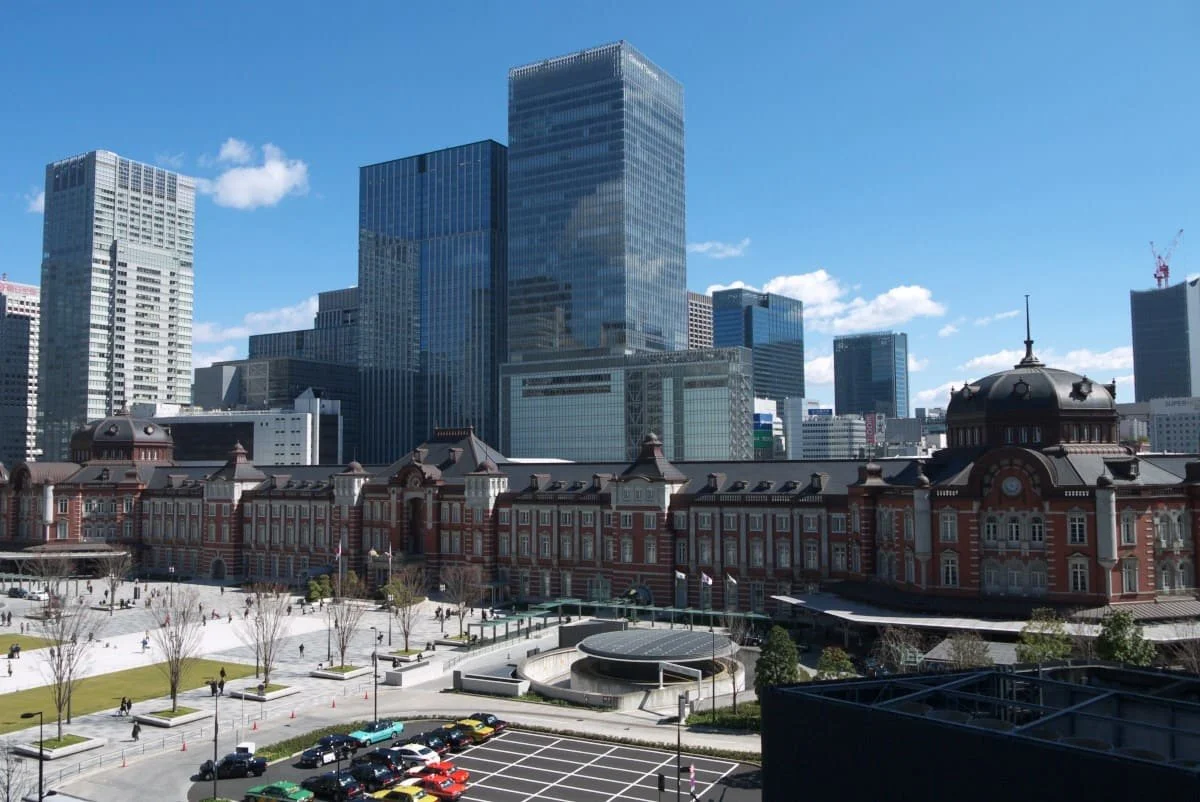
Quartier japonais, Tokyo gare
Crédit Photo : Blog goo.ne.jp
After World War II, Japan suffered massive destruction. The reconstruction of Tokyo, under American supervision, favored reinforced concrete buildings to accommodate a rapidly growing population.
Concrete became synonymous with modernity and efficiency.
In the 1950s, approximately 40% of today’s forests were artificially planted to supply construction timber. Subsequent overexploitation led the government to tighten regulations. Until the early 21st century, Japan imported more wood than it exported. As the country became an economic superpower, foreign materials were widely adopted.
Today, the return to wood is both ecological and cultural.
The Revival of Ancestral Techniques
Between 2010 and 2020, environmental awareness led to renewed interest in sustainable forestry and traditional techniques. The Daisugi method resurfaced, alongside improved forest management strategies.
Craftspeople began relearning ancestral joinery methods. In December 2020, traditional knowledge related to wooden architecture was inscribed on UNESCO’s Representative List of the Intangible Cultural Heritage of Humanity.
The technique known as Shou Sugi Ban — charred wood used for durability and aesthetics — has also regained popularity. We will dedicate a full article to this technique soon.
However, demographic changes — notably declining birth rates and an aging population — have introduced the concept of the compact city. Urban density and land optimization now shape architectural thinking.
Our Japanese Architecture’s favorites
AGRI CHAPEL
BY YU MOMOEDA
In 2016, architect Yu Momoeda designed a chapel within the Nagasaki natural park — a cubic structure with large glazed openings revealing an exposed wooden frame. This “fractal” framework is based on the kanawa tsugi joint method, forming a forest-like interior structure. The space opens toward contemplation of the ocean and surrounding landscape.


Credit : Pen ペン (pen-online.com)
RENOVATION "KYOTO MACHIYA”
BY YOSHIHIRO YAMAMOTO
Another project involves the renovation of small post-war houses, reapplying traditional systems. The historic Machiya timber frames were restored, and original sliding doors were reused within new frames.
Living areas were maximized while sanitary zones were minimized to adapt to contemporary lifestyles and even accommodate new functions such as offices or shops.


SU-PIDER
BY UID ARCHITECTS
One notable example is a house designed for a family of four in a hilly residential suburb of Fukuyama. The dwelling consists of a single 77m² centripetal space enclosed within an octagonal wooden structure. A web-like framework supported by structural legs creates four triangular openings. The interior is composed of modular zones whose functions can evolve over time alongside the family’s needs.


HOUSE KOYOEN
BY TOMOHIRO HATA ARCHITECT & ASSOCIATES
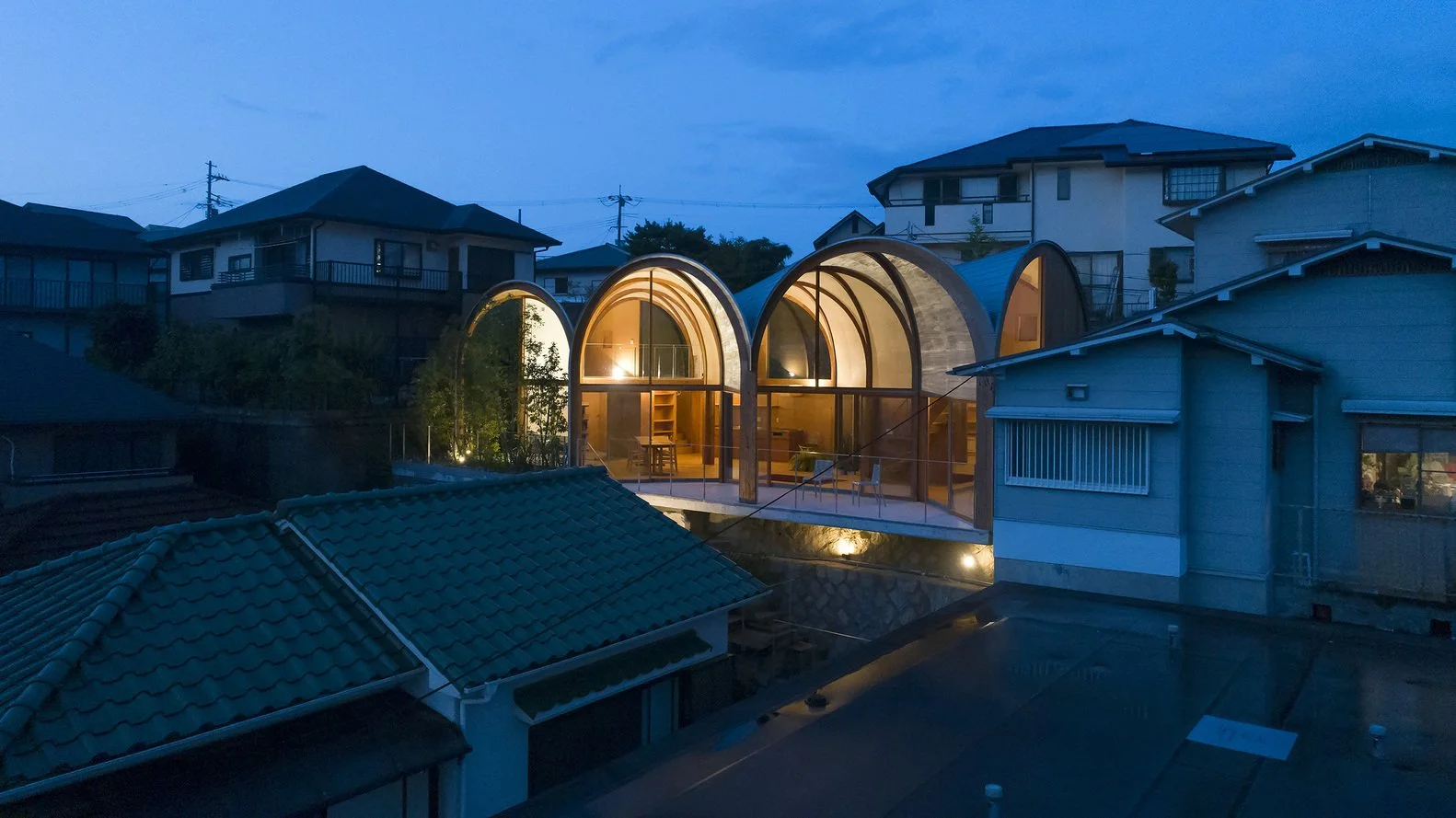
A house built in Hyōgo stands on a hillside landscape with narrow, winding access roads. This context made the delivery of heavy construction materials particularly challenging. For that reason, the architects chose to design a structure that could largely be assembled by hand on site.
The arch was selected as the primary structural form, as it offers remarkable strength — especially in seismic regions. Ultimately, the house is composed of three diagonal vaults formed by a multitude of intersecting arches, covered with laminated veneer panels. The lower section of the central vaults is left open to create a large living space. Multiple entrances punctuate the structure, and light filters in not only from the ends of the vaults but also through the lateral façades.




HOUSE YANAKACHO
BY KACH
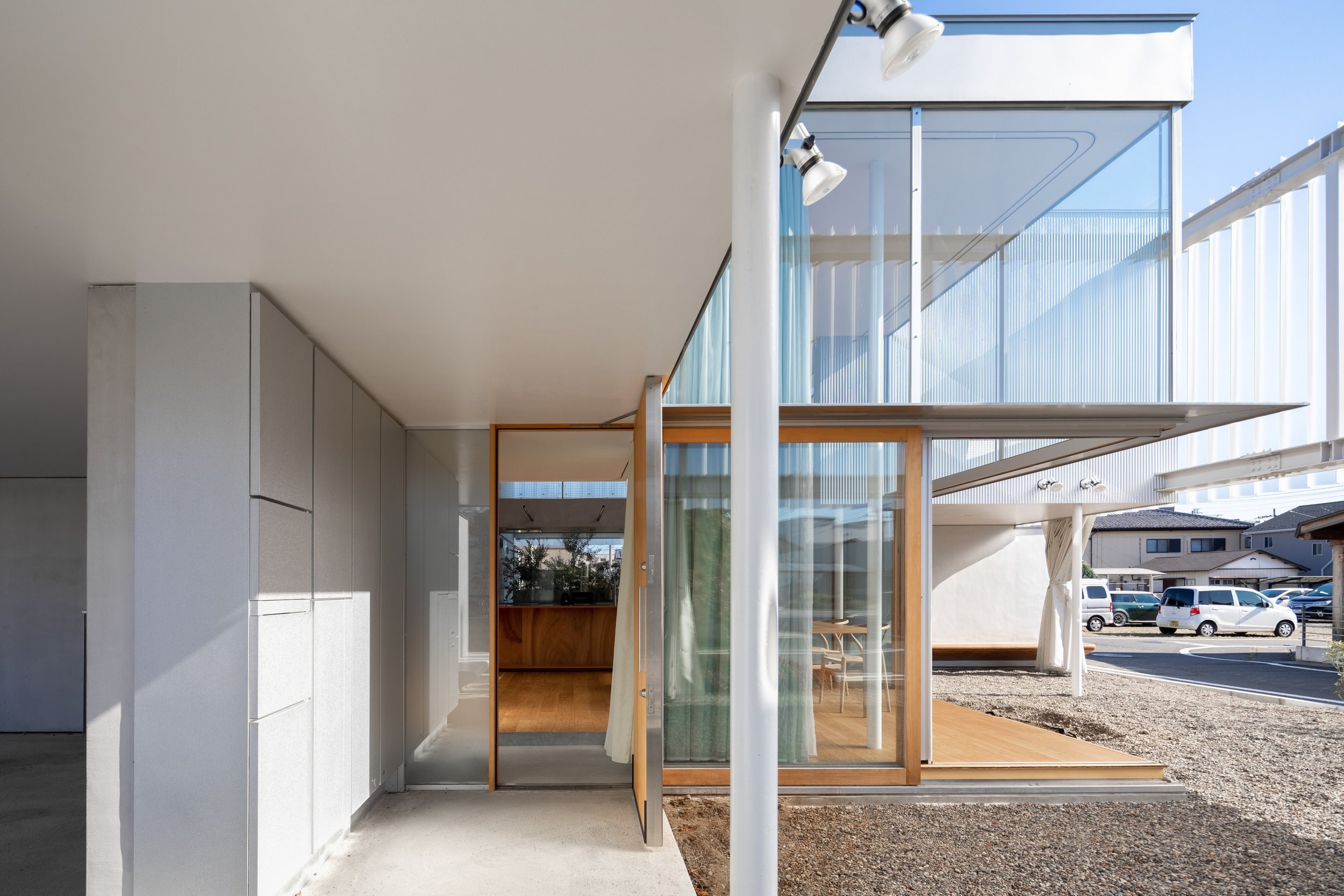
A rectilinear family house in Gunma, located in a residential neighborhood, presents a very different approach. The upper floor — containing the more intimate rooms — is wrapped in a raised translucent polycarbonate enclosure. Below, the ground level opens generously to its surroundings, structured through varying wooden floor heights.
A light curtain can be drawn to modulate the boundary between public and private space, especially in relation to neighboring houses. One must appreciate close proximity and enjoy sociability to fully embrace this architectural gesture.




OGIMACHI HOUSE
BY TOMOAKI UNO
Another cubic house, designed for a single occupant, is constructed entirely of cedar wood from floor to ceiling, with very few openings.
“I proposed a house without windows on the walls, except for the main and rear entrances.”
Instead, five large operable skylights were installed in the ceiling to provide ventilation and daylight. The structure incorporates 32 wooden fasteners and employs the traditional ITAKURA construction method.
It is a singular architecture, toward which we hold a somewhat ambivalent view. The interior may feel enclosed or even oppressive. The owner herself admitted feeling stressed when she first moved in, though she now appears fully comfortable within the space.


MANGA ARTIST’S HOUSE
BY TAN YAMANOUCHI
In Tokyo, a small and atypical wooden house belonging to a mangaka feels almost fictional in its presence. The architectural narrative begins with its façade, conceived as a distorted seismic wall — evoking the ground rising dynamically from the earth. A tunnel carved into this sculptural wall leads to the entrance.
Inside, three levels are connected by a staircase ascending toward the main source of light: a central void that functions almost like an internal courtyard. Additional openings allow daylight to enter, though sparingly. Architect Tan Yamanouchi intentionally plays with chiaroscuro contrasts.
He describes these spaces as “ponds and shores.”
The house offers flexible and highly personal spaces, perfectly suited to the daily life of a mangaka seeking inspiration. Since the COVID-19 pandemic, the private residence has also become a meeting space, an interview studio, and even temporary accommodation for members of the press.


HOUSE PLYWOOD
BY ALPHAVILLE ARCHITECTS
On a street corner in Kyoto stands a small rectilinear house that appears simple from the outside. Inside, however, it unfolds like an origami composition, with folded interior walls shaping nine functional units.
An upper-level terrace allows residents to engage with both the street below and the sky above.
“Our aim was to merge artworks and folding walls within this building so that the living spaces could serve as a small gallery, displaying the master’s drawing collection when friends or guests are invited.”


SUNNYHILLS
BY GUMA YUNKO
Since 2013, in the dense urban fabric of Tokyo, one can spot from afar what appears to be a cluster of branches swaying in the wind between high-rise buildings.
“Our goal was to create a forest in the middle of the bustling city.”
Upon approaching, the structure reveals itself as a café built with an interwoven wooden system inspired by the traditional Jigoku-gumi method, combined with glass façades. Natural light filters through diamond-shaped wooden latticework. Inside, cork tile flooring and two levels connected by an irregular staircase reinforce the handcrafted atmosphere.
For architect Kuma Kengo, it is essential to highlight trees and natural materials such as wood and paper rather than rely on concrete. His work does not appeal to everyone in Japan, yet it strives to reintroduce ancestral craftsmanship into contemporary discourse.
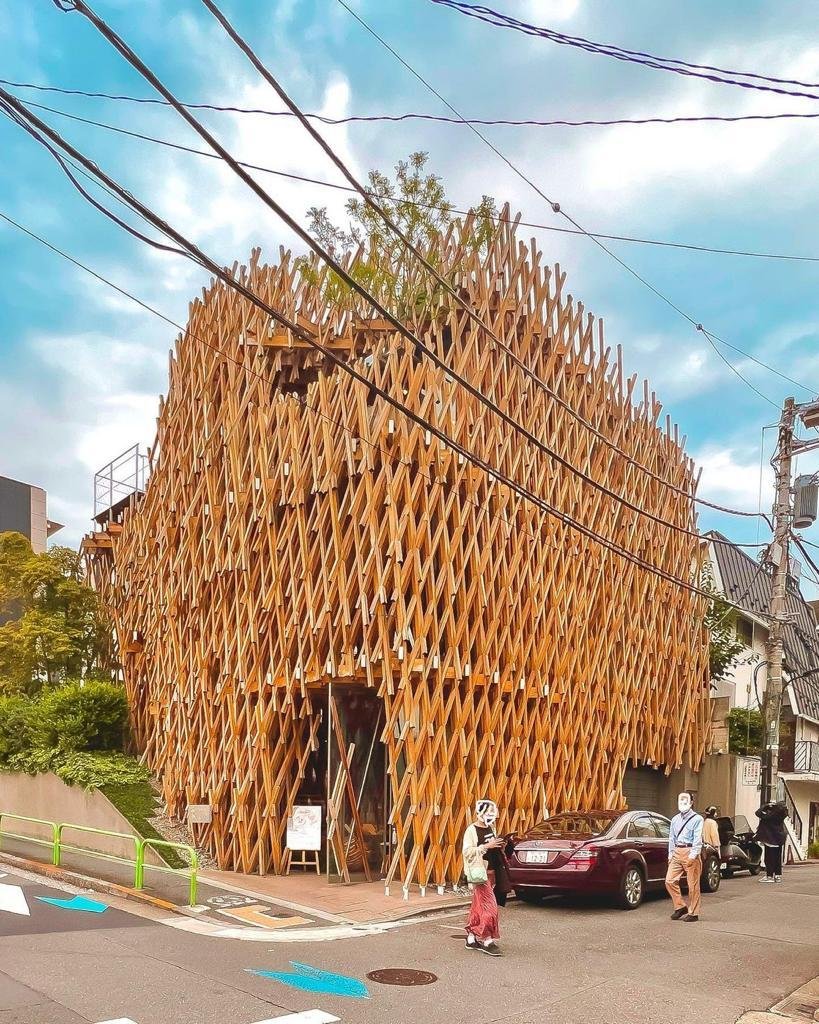


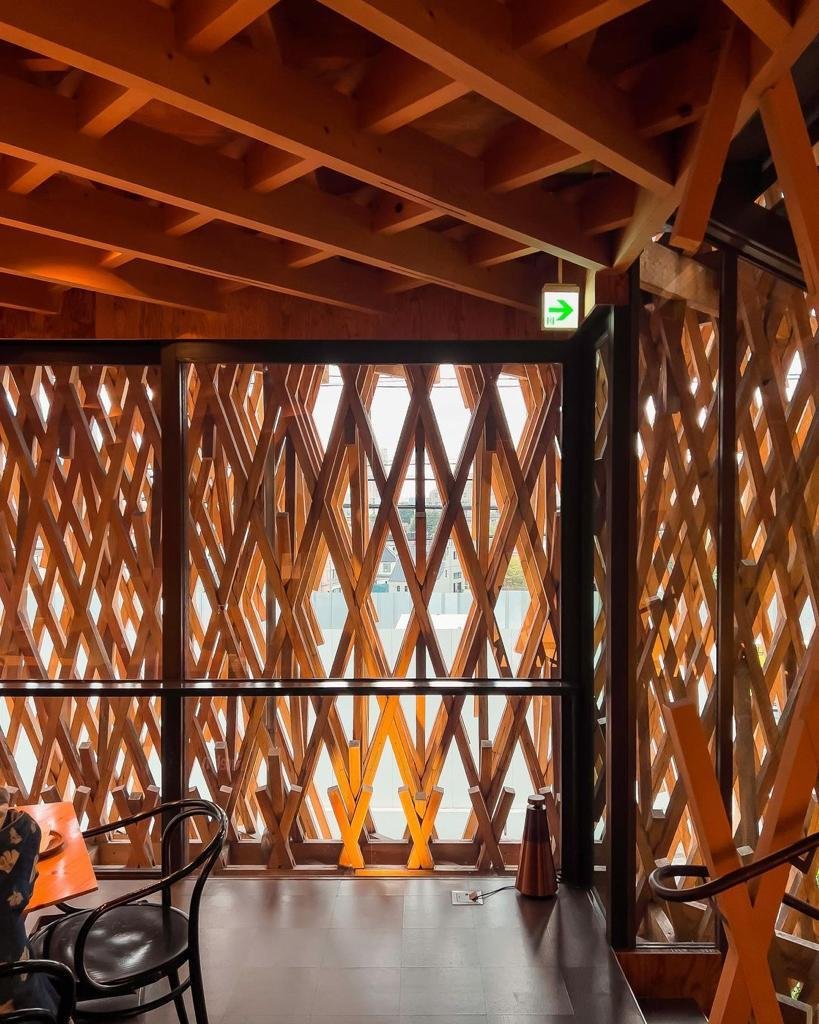

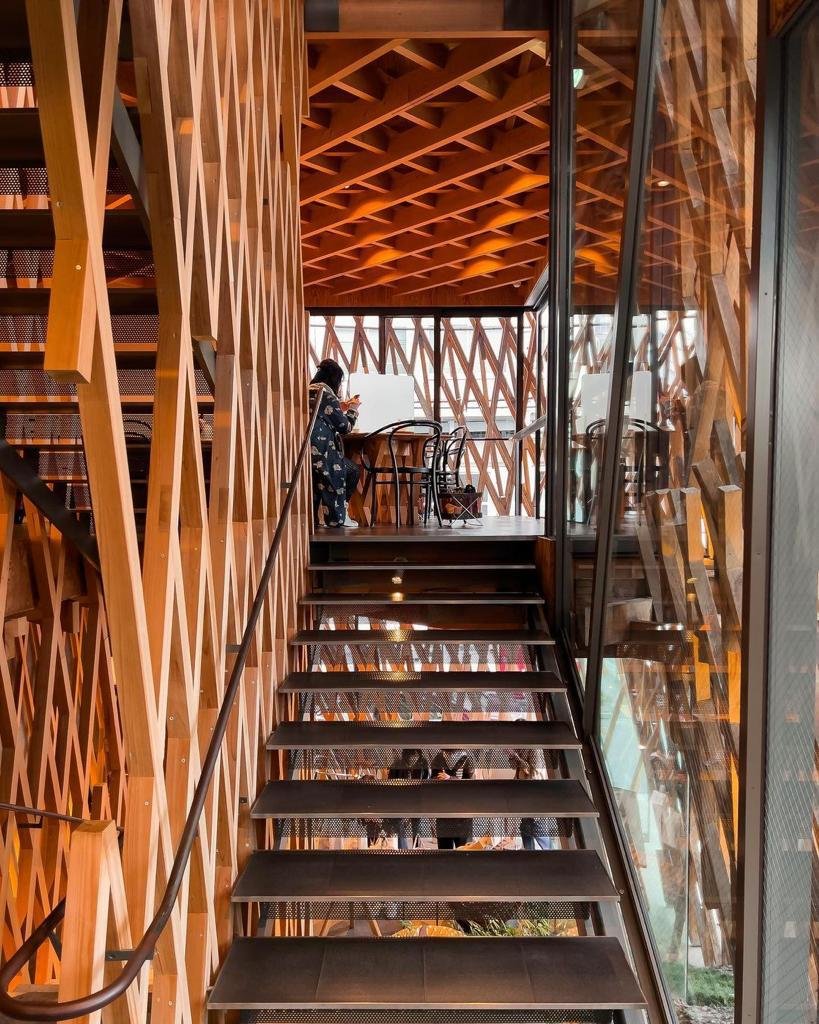


Credit: Instagram / @architechu
Conclusion
Today, traditional Japanese carpentry and joinery techniques are recognized worldwide for their structural intelligence and refined minimalism. Many architects reinterpret and reinvent these ancestral methods to shape the architecture of tomorrow.
Perhaps what is most compelling is not simply the return of wood, but the way these projects demonstrate that innovation can coexist with heritage — and that tradition, when reexamined, can become radically contemporary.
