
The Metamorphosis of Radiators into Design Objects
In interior design, we often forget that radiators can become design pieces in their own right.
For many years, radiators were one of those elements in our interiors that attracted criticism. Historically, professionals focused primarily on their technical performance, often neglecting aesthetics during the design process. Once installed — usually beneath windows — they were perceived as bulky, poorly positioned, heavy, dusty, and simply unattractive.
In this article, we invite you to discover how designers have transformed radiators over time, and we share a few ideas on how you can rethink them in your own space.
I. Designer Radiators
With the arrival of electric radiators, manufacturers were able to make them more discreet — often slimmer and finished in white. As electric heating systems became more widely commercialized in the 1970s, designers began collaborating with manufacturers to create radiators that combined technical innovation with improved aesthetics.
This evolution did not only bring thermal comfort, but also visual comfort. By the 1980s, the radiator had become a design object in its own right.
Today, many brands and designers offer radiators and towel warmers in bold colors and sculptural forms, creating striking contrasts within interiors. Among them are Varéla Design, Arbonia, Acova, and Tubes.
VARELA DESIGN

One of the pioneers in this previously male-dominated field was Varela. She introduced her British brand to the French market in the 1990s and became a market leader by 2005. Over time, the company evolved toward fully French production.
In the early days, this unconventional approach to radiator design was not easy to sell — particularly as a woman in a highly technical industry. She had to reassure clients and consistently demonstrate the credibility and performance of her products.
As she puts it:
“This is not decoration designed simply to please without substance, which would, in my humble opinion, be far too easy.”
Portrait of Varela
Credit: VD
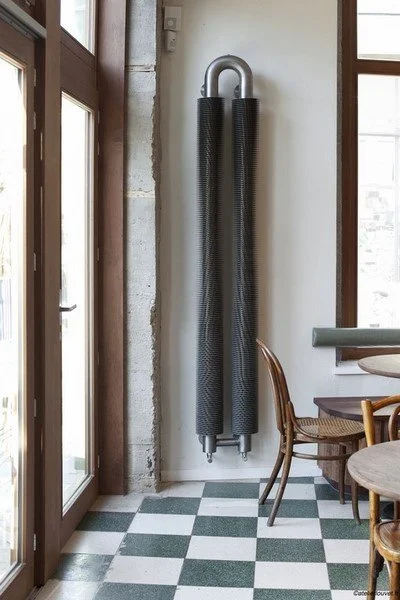
One of her signature models, recognizable for its pinhead shape and its retro-industrial aesthetic, integrates beautifully into large contemporary spaces.
Credit : VD
ARBONIA

The Rondotherm model by the ARBONIA Group goes even further by incorporating two additional functions: a mirror and a coat rack. This Swiss brand manufactures both hot-water and electric radiators, as well as decorative heating panels. Since the early 2000s, all production has been carried out entirely in Europe (Germany, Switzerland, the Czech Republic, and France).
Rondothermde Radiator
Credit : Magazine Elle Décoration
ACOVA
The team at Acova designs its radiators drawing on French craftsmanship, with a strong commitment to integrating environmentally responsible solutions at every stage of production. Acova was one of the first brands to introduce a range of decorative radiators and towel warmers. Today, they offer more than 50 different color shades for their finishes.

Karéna radiator.
Credit : Acova
TUBES
Another brand equally committed to sustainable production — both for the environment and for the people who live with their products — is Tubes. They use 100% recyclable materials and nanotechnology-based paint, significantly reducing water consumption, waste, and energy use during production. Their collections include an impressive range of dimensional variations, 140 colors, 14 galvanic finishes, and numerous accessories. Since 2004, their design collections have been developed in collaboration with various international designers.
Square collection, 2004
Credit : Tubes

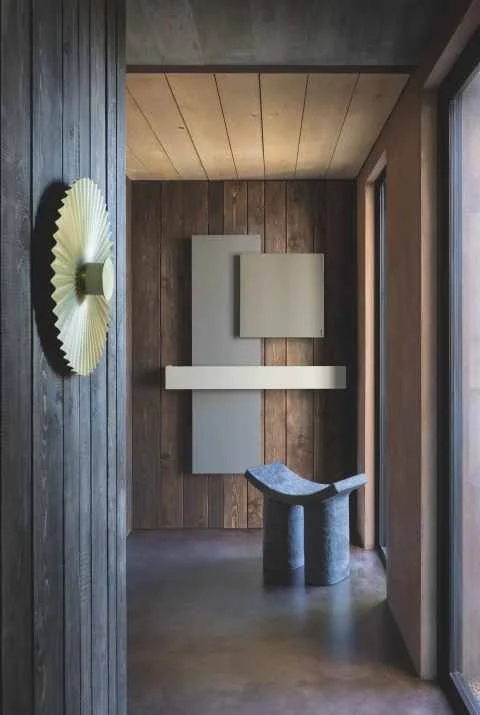
Their 2021 I Ching collection, created by Elisa Ossino, features a minimalist stainless steel electric radiator with a pure, refined silhouette and touch control. The system allows for multiple wall compositions, making it equally suitable for a bathroom — with a few towels elegantly suspended — or a living space.
Radiator I Ching
Credit: Tubes
Today, the infinite configuration possibilities available transform the radiator into a true decorative element rather than a purely technical necessity.

One of their 2006 collections achieved remarkable success. Asotori, designed by Ponti Associa, introduced the Milano Free-Standing — an electric radiator conceived as a sculptural steel piece designed to stand proudly in a living room.
This radiator was endorsed by the curator of Die Neue Sammlung and selected for the museum’s permanent design collection at the International Design Museum Munich — a clear recognition of its artistic and cultural value.
Plug&Play Milano Tubes
Credit : Magazine Elle Décoration
Increasingly, some designers now describe their radiators as true works of art to be displayed at home. This is the case for the Italian brand Ridea and the French brand Cinier.
RIDEA

The electric or hot-water model Flower Power by Ridea is presented by the brand as an icon — an emblem of design seamlessly combined with functionality.
As they state:
“Technology is not visible, but it is felt through thermal performance.”
Radiator Flower Power
Credit : Ridea
CINIER

Granit Cuivre Radiator
Credit : Ciner
The Granit Cuivre model by Cinier is identified as a unique piece crafted in blackened coppered metal. It resembles an ethnic sculpture, evoking a carved door from distant lands. The radiator is enhanced with hand-applied metallic paint by the artist, reinforcing its status as a collectible design object rather than a purely functional element.
Steel remains one of the most widely used materials in radiator manufacturing, prized for its efficiency and versatility. However, alternative materials are increasingly explored — including wood.

The VD3908 model by Varéla Design is made of oak and features five adjustable shelves, combining heating performance with functional storage in a subtle architectural gesture.
Radiator in Oak
Credit: VD
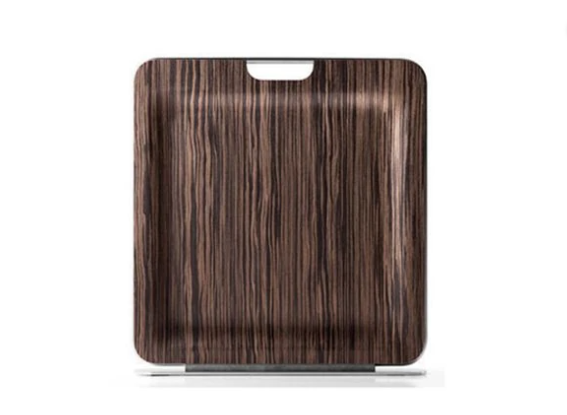
Another example is the portable Bag model by I-Radium. For this Italian brand, it was essential to pair infrared heating technology with a noble material such as solid wood — not only for aesthetic reasons, but also because wood historically served as one of humanity’s primary heating fuels. Here, material memory meets contemporary technology.
Portable Radiator bag in oak
Credits: I Radium

II. Customized Radiators
We are fully aware that replacing a radiator with a design-led model represents a significant investment (around €3,000 per piece). For many homeowners — especially those who have just purchased a property and are already planning substantial renovation works — this is understandably not a priority.
When living in or renovating older buildings, it is common to encounter white cast-iron radiators. Many associate them with their grandparents’ homes and often perceive them as outdated or visually heavy.
But there is no need to rush into replacement. With imagination and thoughtful detailing, these existing pieces can become strong decorative elements.
We have therefore gathered a few ideas to help you rethink and transform your radiators rather than remove them.
If you opt for color, two directions are possible.
The most discreet option is to let the radiator merge into its surroundings. Painting it in the exact same shade as the adjacent wall — or even the floor — creates a seamless visual continuity. Instead of standing out as a technical object, it becomes part of the architectural composition.
This strategy works particularly well in contemporary interiors where material coherence and tonal harmony are key.

Radiateur fondu avec le murs
Crédit Photo : Farrow & Ball - Pinterest
Ou alors misez sur la visibilité en créant un constate de couleurs tout en restant en accord avec l'ambiance de votre intérieur et ainsi apporter un peu de Peps.

Radiateur contrasté par rapport au murs
Crédit Photo : Magazine Déco Idée - Pinterest
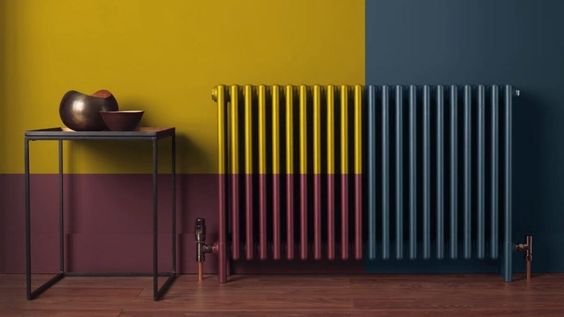
Radiateur peinture géométriquement coloré peps
Crédit Photo : casaideadesign.it -Pinterest
A Quick Note on Materials
We recommend selecting the radiator paint at the same time as your wall finishes to ensure harmony.
It is essential to consider the material of your radiator before choosing the paint. Depending on the surface, you may opt for acrylic, oil-based (glycero), or spray paint — but always ensure the formula is heat-resistant.
For application:
Use a flat “fitch” brush (queue de morue) for broad coverage
A round brush (rechampi) to reach detailed or narrow areas
A lacquer roller for flatter surfaces
Preparation is everything. Proper cleaning and light sanding will make all the difference in achieving a refined result.


Styling Around the Radiator
Another approach is to design the wall around it as a curated vignette — almost like a moodboard dedicated to your travels or creative inspirations.

Credit : Magazine Déco Idée - Pinterest
You can layer:
Framed photographs
Vintage finds
Small trays or catch-alls
Plants
Candles
Even a discreet LED light strip to enhance depth
In this spirit, adding a slim shelf above the radiator can work beautifully — but always maintain a minimum distance of 3 cm to allow proper heat circulation.
Some designers, such as Byung-seok with his Natural Wave concept, explore custom shelving solutions that integrate heating elements into sculptural compositions.

Credit : homelisty- Pinterest
Certaines marques comme Natural Wave de Byung-seok proposent des tablettes sur-mesure comme celle-ci :

Credit : Blog “on.chair.at.a.time”

It’s even possible to create a library around your radiator!
Credit : madamedecore.com - Pinterest
Concealing your radiator
If your radiator is severely damaged or completely out of sync with your interior, a custom cover (coffrage) may be the right solution.
The structure must include perforations or a grille to allow heat to circulate effectively. If you are comfortable with DIY projects, you can build it yourself — otherwise, collaborating with a carpenter or designer will ensure a made-to-measure and refined result.
Be mindful of performance: a cover can affect heating efficiency depending on the radiator technology. Radiant systems, which distribute heat evenly, are generally more impacted by enclosures than inertia-based radiators.
You can even give this structure a second function. A radiator cover can transform into a bench — especially beautiful beneath a window, paired with a small bookshelf. A warm reading nook, quite literally.


You can even give this structure a second function. A radiator cover can transform into a bench — especially beautiful beneath a window, paired with a small bookshelf. A warm reading nook, quite literally.


CONCLUSION
We hope these ideas encourage you to see your radiator differently — not as a constraint, but as an opportunity. At Studio Bisson, we frequently encounter this challenge when designing bespoke interiors. Instead of hiding technical elements, we push our creativity to integrate them seamlessly and elegantly into the overall composition. And perhaps this is the real shift: treating every constraint as a design brief in disguise.
