
Bespoke Staircases — A Central Element of Your Interior
Today, let’s focus on a key feature in any interior… the staircase!
From the technical criteria used to design your made-to-measure staircase to the best materials to choose, here’s everything you need to know in this new article.

Credit: Pinterest
1. The Criteria for a Well-Designed Staircase
The criteria we’re presenting here apply to residential spaces.
When we walk up a staircase, it usually feels like a natural movement. Yet, a poorly designed staircase — with uneven or badly proportioned steps — can instantly make us stumble! So, let’s look at what makes a staircase both functional and comfortable.
The number of steps, their height, depth (tread) and width are all essential aspects to consider when planning your staircase. To determine these, we look for the right balance between comfort and available space.
Step Height
The “ideal” step height — meaning very comfortable — is around 17 cm.
However, we don’t always have enough room. In fact, the higher the step, the fewer steps you’ll have overall, which helps save floor space.
We can go up to 21 cm for a straight staircase and 23 cm for a spiral one.
Finally, the total height to climb will precisely determine the height of each step.
Tread Depth (Giron)
The tread depth, or giron in French, is the distance from the front edge of one step to the next — the surface where your entire foot lands.
To calculate the ideal tread depth, 17th-century architect François Blondel developed what’s known as Blondel’s Law, which states:
The tread depth plus twice the riser height should total between 60 cm and 65 cm, with the optimal comfort at 63 cm.
So, if our riser height is 17 cm, the ideal tread depth would be:
63 – (2 × 17) = 29 cm (or between 26 cm and 31 cm).
And if the riser height is 21 cm:
63 – (2 × 21) = 21 cm (or between 18 cm and 23 cm).
Stair Width
The width of the staircase should be at least 70 cm to remain comfortable, and ideally between 80 cm and 100 cm if you want two people to pass each other easily.
This is roughly the same width we usually allow for a doorway.
In some cases, when space is particularly limited, the width can be reduced to 60 cm.
Credit: Pinterest
STAIRCASE GLOSSARY
If all this jargon feels a bit confusing, here are some of the most common terms used when talking about staircases:
Tread (Marche): The main element that forms the staircase — the step you walk on to go up or down.
Stair Width (Emmarchement): The width of the step, i.e., the walking space.
Tread Depth (Giron): The depth of the step — the distance between the front edges of two steps.
Riser (Contremarche): The vertical part between two treads.
Nosing (Nez de marche): The overhanging front edge of a tread that extends beyond the riser.
Line of Travel (Ligne de foulée): The central line of movement along the staircase, dividing the width of the steps in half.
Stringer (Limon): The structural element that supports the steps.
Flight (Volée): A continuous run of steps without interruption (like between two landings).
Landing (Palier): The platform separating two flights of stairs.
Footprint (Encombrement): The amount of floor space the staircase occupies.
Stairwell Opening (Trémie): The ceiling opening where the staircase reaches the upper floor.
Supporting Wall (Échiffre): The wall on which the staircase is supported.
2. Which Staircase Style Should You Choose?
At Studio Bisson, we love everything clean-lined and crafted from raw wood!
But of course, not every staircase suits every space. Here’s how to choose the right type according to your needs and constraints.
Credit: Pinterest
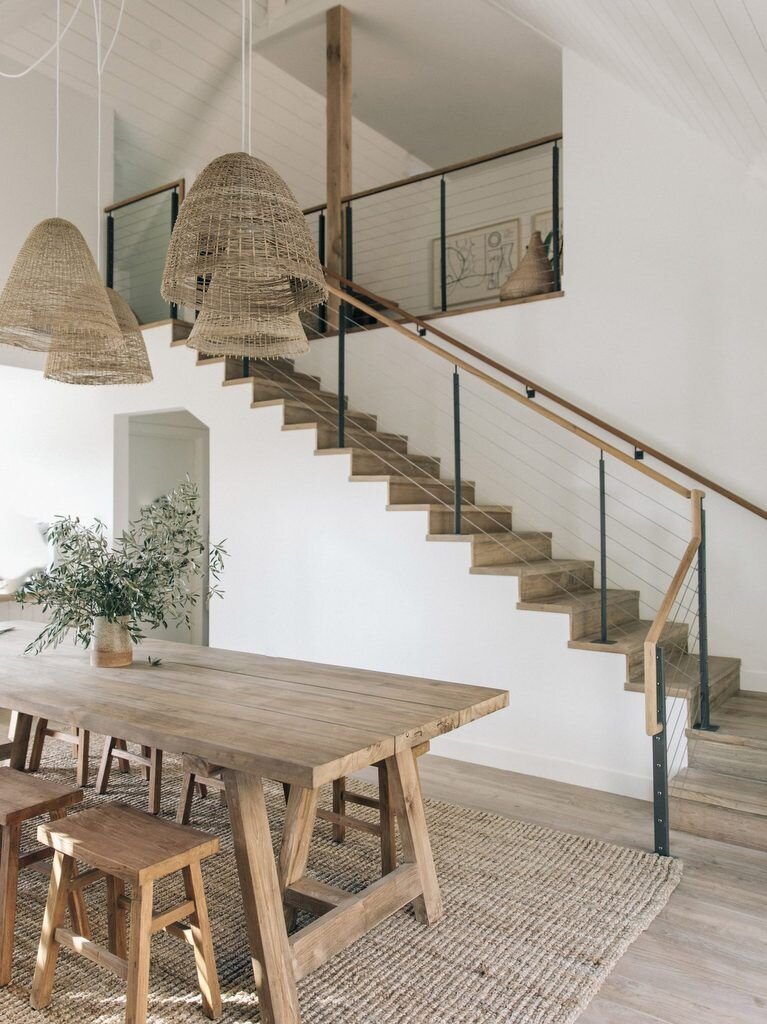
Straight Staircase
Also known as the “French-style” staircase, this is the most common type — simple in design, with dimensions that are relatively easy to calculate.
Its advantage? It can be installed against almost any supporting wall (échiffre).
Its downside? It often requires more floor space.
However, this can be adjusted by playing with step height or adding a turn or landing at one or two levels.
If you’re looking to maximize space, this is the perfect option to integrate storage solutions beneath the stairs — drawers, cupboards, a bookshelf, a desk, or even a small kitchen!
Credit: Pinterest
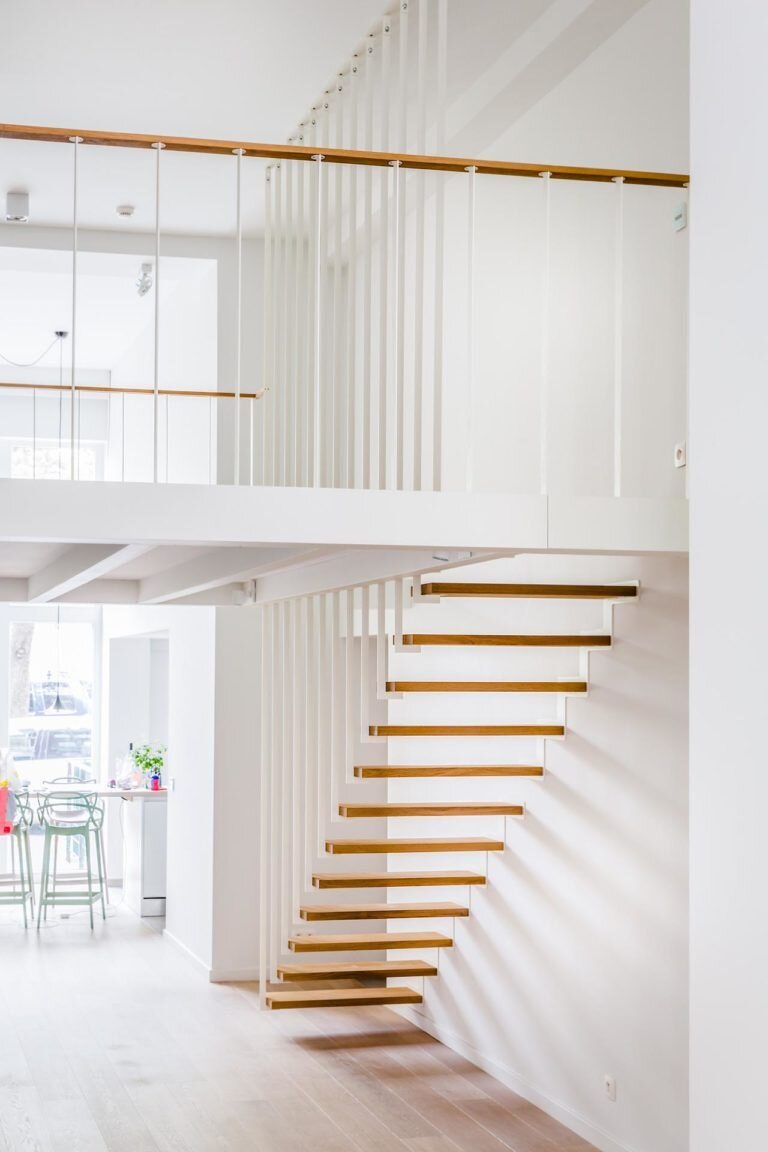
Floating or Suspended Staircase
At Studio Bisson, we’re in love with this airy, minimalist design!
It has no risers and no visible stringers; each step is anchored directly into the supporting wall (échiffre).
While this staircase brings a stunning architectural statement to any interior, it’s not suitable for all situations. It requires the supporting wall to be load-bearing in order to safely carry the weight of the treads and anyone walking on them.
Don’t worry — there are plenty of beautiful alternative options that maintain a light, open look while ensuring stability.
For example, a central steel stringer painted the same colour as the wall can stay discreet, and without risers, you still get that contemporary loft feel.

Credit: Pinterest
Spiral Staircase
A spiral staircase has a helical shape.
Its main advantage is, of course, space saving!
Because it turns around a central axis, it takes up very little floor space.
It also allows for taller risers — up to 23 cm instead of 21 cm for a straight staircase.
And beyond practicality, a spiral staircase instantly adds a Parisian studio charm that we absolutely adore!
3. Which Materials to Choose?
Metal, concrete, wood… or a mix of all three? The choice of material will have a major impact on both the cost and the style of your staircase.
Métal
A metal staircase gives an industrial touch to your interior. You can opt for steel or stainless steel — both very trendy right now. They’re solid, durable, and timeless. The downside? They retain a cold feel underfoot, and metal tends to be the most expensive material option.
Concrete
Also very modern, concrete is long-lasting and can be finished in many ways: raw, sanded, or polished. It’s also relatively affordable. However, at Studio Bisson, we’re slightly less fond of it due to its environmental impact, especially in the manufacturing phase.
Wood
Wood remains the most popular material for staircases. It offers endless aesthetic possibilities, is sturdy yet easy to install, and — best of all — it’s often the most affordable and eco-friendly option when responsibly sourced and finished. No surprise here — we can only recommend this noble material, one that’s truly close to our hearts.
